
The City of Pandas, Tea and Slow Living — a Traveller's Companion from Eastertrip.com
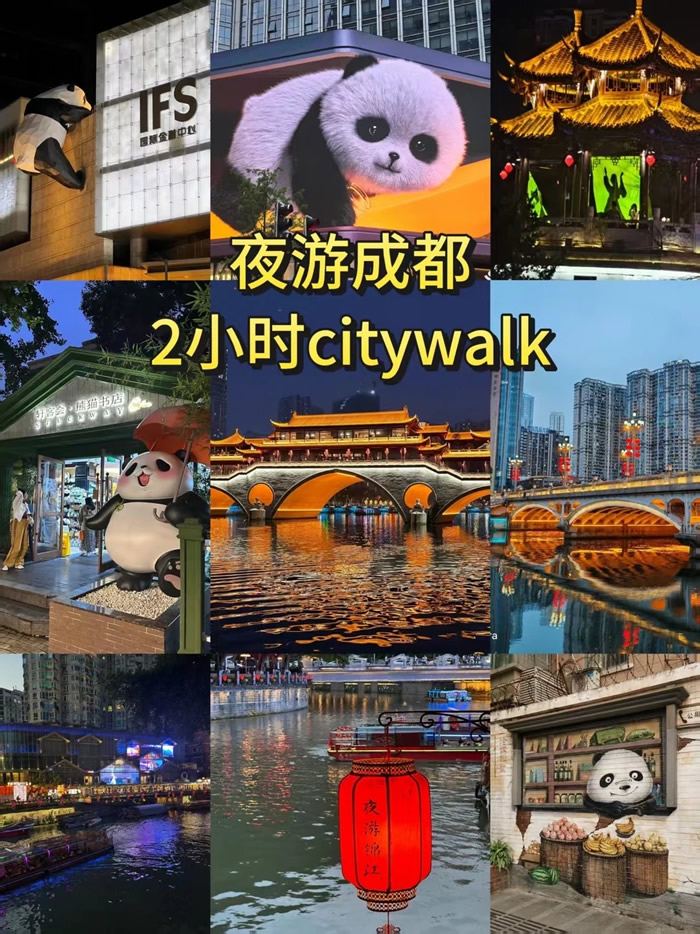
Figure 1 Chengdu welcomes you with pandas, tea steam and glowing lanterns (illustration by Eastertrip.com)
Welcome to Chengdu
Picture your first moments in Chengdu: you step out of the terminal, and instead of a hurried city rush the air feels different — softer, warmer, unhurried. This is the capital of Sichuan, the heart of a fertile basin the Chinese call the “Land of Heavenly Abundance.” Locals greet one another with a question that says everything about the city: “Have you eaten yet?” — and everywhere you look, people are doing exactly that, slowly and with great enjoyment.
Chengdu is a marvellous paradox. It is a megacity of more than twenty million people, yet it ranks year after year among China’s happiest cities. Its ancient alleys whisper of poets and strategists who walked here a thousand years ago, while its modern districts shine with the architecture of a new century. And in the green hills just beyond the city, giant pandas — the friendliest ambassadors in the natural world — munch bamboo as if time has never mattered. This guide tells you where to go, how to get there, and how to read the city like a local.
Every place featured here is a favourite of international travellers, and every suggestion has been kept practical: opening hours, the exact Metro line or train you need, and honest advice on what not to miss. Admission arrangements change with the seasons, so before you set out, always confirm current opening hours and booking rules on the official website.
Why Chengdu Captivates Travellers
Four things define the Chengdu experience, and you will meet all of them within your first 24 hours:
• The Giant Panda. With around 70 giant pandas in residence, the breeding base outside town is the best place on Earth to watch these gentle creatures eat, climb and doze. Go early, when they are most active.
• The Food. Sichuan cuisine is one of the world’s great culinary families — hotpot, mapo tofu, dan dan noodles and the numbing tingle of Sichuan pepper. Dining here is a social ritual, not a refuelling stop.
• The Tea Culture. Chengdu is China’s original tea city. Locals sit in park teahouses with a covered bowl of jasmine tea, chatting, playing mahjong and getting ears cleaned — an art of doing nothing, beautifully.
• Three Kingdoms & Poetry. This was the capital of Shu, the kingdom of Zhuge Liang, and the home of Du Fu, China’s greatest poet. History here is not confined to museums; it lives in temples, lanes and everyday speech.
Top Attractions for International Visitors
The sights below are arranged the way travellers usually experience them: the unmissable icons first, then the cultural treasures of the old city, then the day trips beyond. Metro stations and practical notes are included for each.
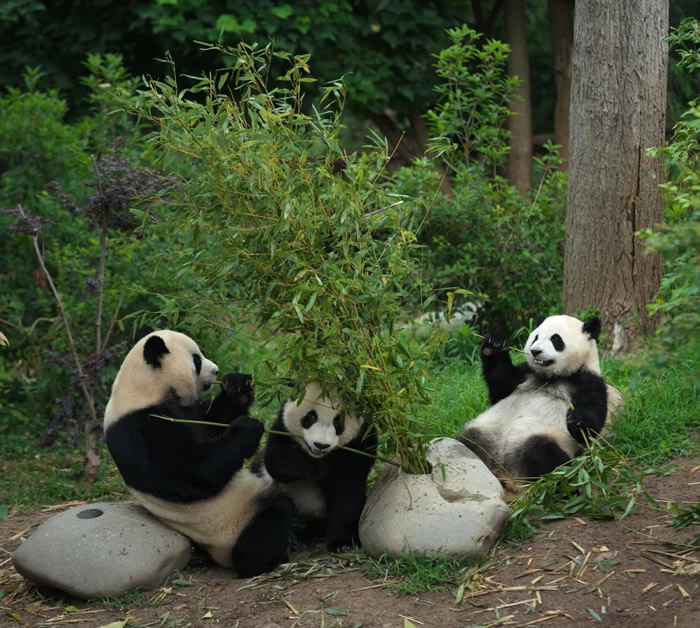
1. Chengdu Research Base of Giant Panda Breeding
Arrive before the crowds and you will hear the bamboo before you see the pandas — a soft, constant crunching. The base, opened in the 1980s with just six rescued pandas, now shelters a thriving community of around seventy, along with red pandas and rare birds. Morning is magic hour: between eight and ten the pandas are at their liveliest, wrestling in the bamboo groves and climbing the wooden platforms. The Moonlight Nursery is the crowd’s favourite, where keepers care for newborn cubs in spring and summer.
2. Kuanzhai Alley (Kuan Zhai Xiang Zi)
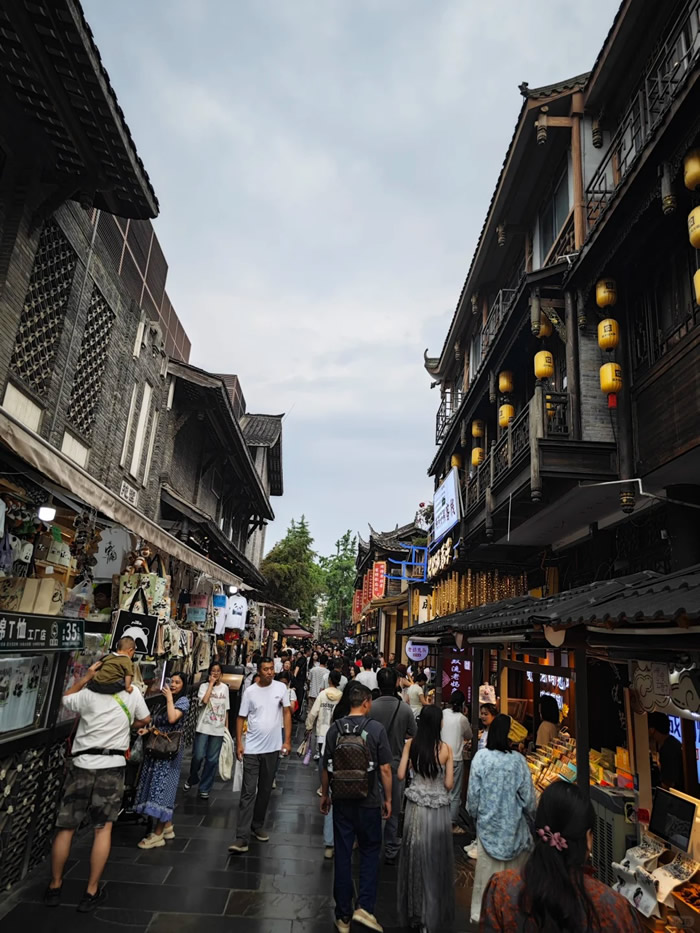
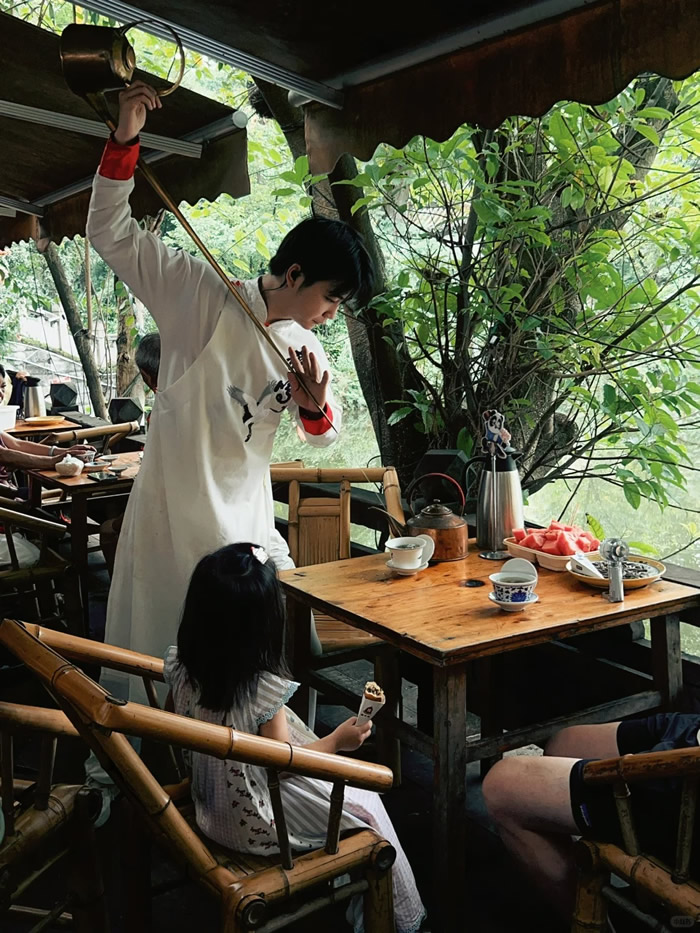
Three parallel lanes in the old city — Wide, Narrow and Well — hold the flavour of Chengdu’s courtyard life. The lanes were built in the Qing Dynasty for the Manchu garrison, and their grey-brick walls, carved doors and plane trees have been gently restored rather than rebuilt. Walk the narrow lane in the morning for quiet courtyards, return in the evening when the red lanterns glow and the tea houses fill. The architecture tells a story; the snacks — sweet-scented tofu, sugar paintings, and the famous “three cannon” tea-pouring show — tell another.
3. Wuhou Shrine & Jinli Ancient Street
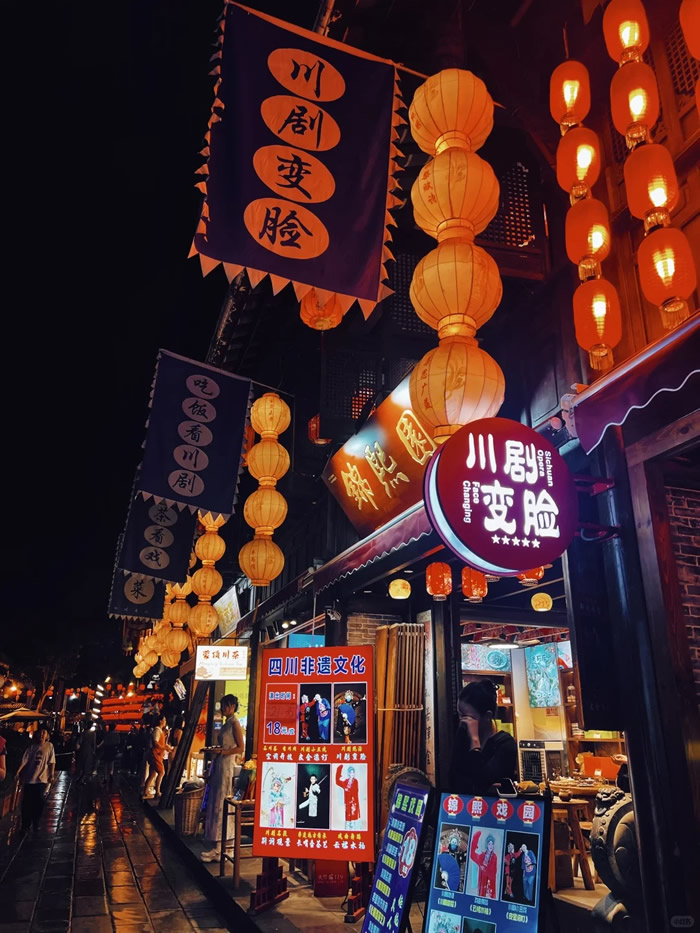
Together, these two neighbours offer the perfect half day. Wuhou Shrine is China’s most revered memorial to Zhuge Liang, the master strategist of the Three Kingdoms, and to Liu Bei, the founder of Shu. Its forest of cypress trees and the famous red-wall bamboo corridor are among the most photographed corners of Chengdu. When you step out through the side gate, you land directly in Jinli, a lively bazaar of teahouses, shadow-puppet theatres, lacquerware shops and street musicians. Jinli is free, and at night — when hundreds of lanterns light the eaves — it feels like a festival that never ends.
4. People's Park (Renmin Gongyuan)
If you want to understand how Chengdu relaxes, spend a morning in People's Park. This is where the city comes to do nothing, beautifully. At the He Ming Teahouse — a teahouse for over a century — order a bowl of jasmine tea (about CNY 30, with free refills of hot water) and watch the show: mahjong tiles clicking, grandparents showing off their singing voices, and the city’s famous ear-cleaning masters working their silver tools with theatrical flair. The park is small, green and utterly absorbing; two hours will vanish.
5. Chunxi Road & Taikoo Li
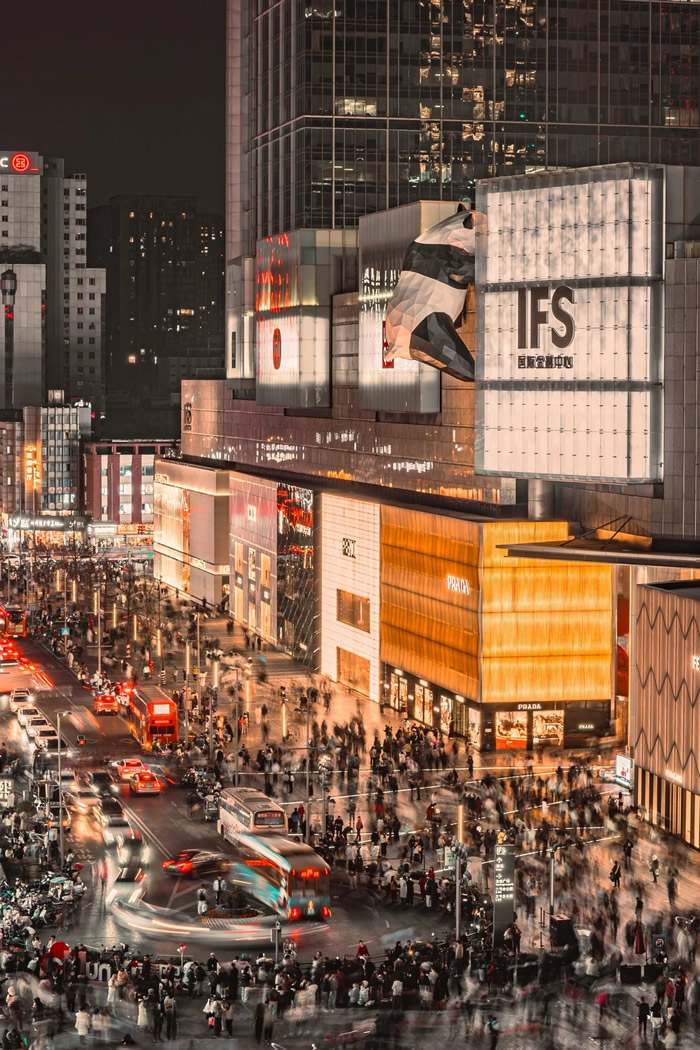
For the modern face of Chengdu, take the Metro to Chunxi Road. This is the city’s grand shopping street, and at its eastern end rises Taikoo Li — an open-air complex of low-rise lanes, glass pavilions and heritage courtyards that has become one of the most admired pieces of retail architecture in China. The giant panda climbing the wall of the IFS tower is the city’s most beloved photo stop. Even if you never enter a single shop, the lane-by-lane stroll between the old temple of Daci and the designer boutiques is a pleasure in itself.
6. Qingcheng Mountain & Dujiangyan Irrigation System (Day Trip)
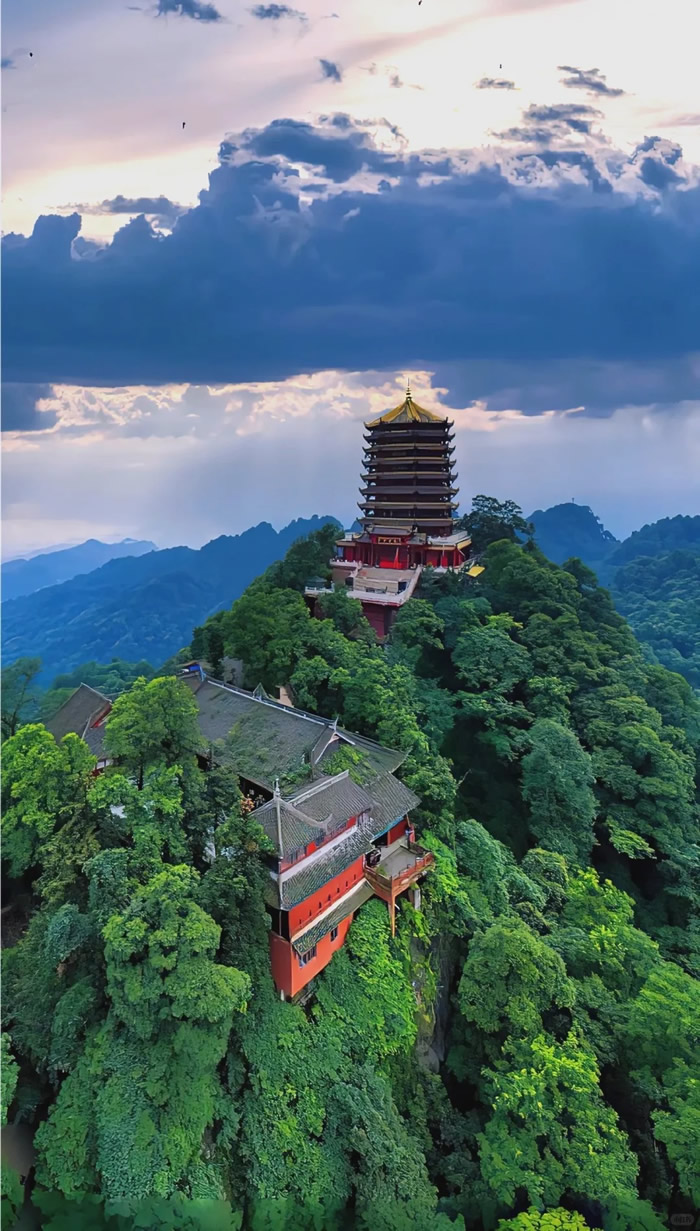
Two UNESCO World Heritage sites, one easy day, both just northwest of Chengdu. Dujiangyan is one of the great engineering achievements of the ancient world: built in 256 BC, it has irrigated the Chengdu Plain for more than 2,200 years without a single dam across the river — still functioning, still admired. Cross the swaying Anlan Bridge, walk the Fish Mouth levee, and let a guide explain how water, stone and bamboo tamed the Min River. In the afternoon, climb Qingcheng, the birthplace of Taoism, whose misty peaks, mossy paths and Daoist temples inspired the name “the most tranquil place under heaven.”
7. Leshan Giant Buddha (Day Trip)
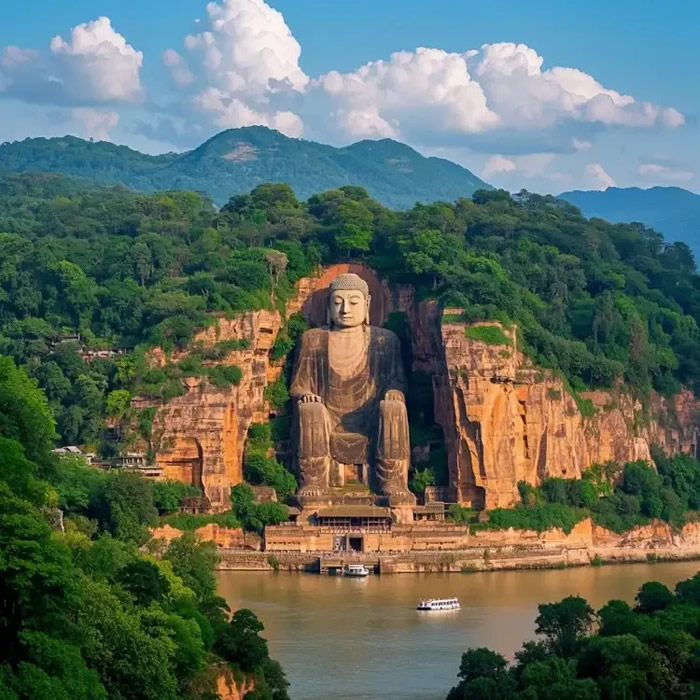
For more than 1,300 years, a 71-metre stone Buddha has sat calmly where three rivers meet at Leshan, facing the water to calm it. Carved from a cliff face between AD 713 and 803, it is the largest ancient stone Buddha in the world, and its toenail alone can hold a seated person. Two perspectives reward you: descend the Nine-Bend Plank Road for the full face-to-face view, then take a short boat ride on the river for the classic panorama — the Buddha, the cliff and the two guardian mountains, like a giant sleeping in the landscape.
8. Mount Emei (1–2 Days)
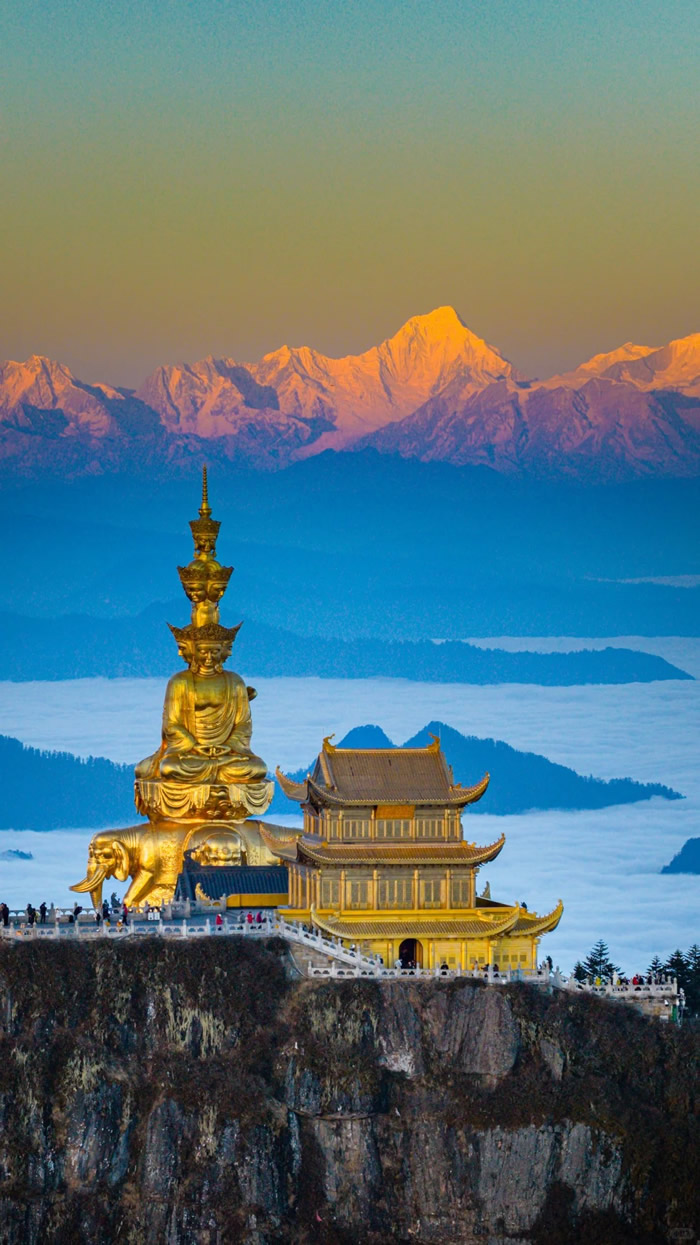
For travellers with a day or two to spare, Mount Emei is the grand finale of the region. One of China’s four sacred Buddhist mountains, it rises to 3,099 metres, and pilgrims have climbed its stone stairways for fifteen centuries. In a single ascent you pass through temperate forest, cloud forest and alpine meadow. The summit — the Golden Summit of Huazang Temple, crowned by a golden statue of Samantabhadra — offers a sunrise that draws travellers from across the world. Wild monkeys patrol the paths (guard your snacks), and the view from the summit on a clear morning is worth every step.
9. Sichuan Opera — Face Changing (Evening Option)
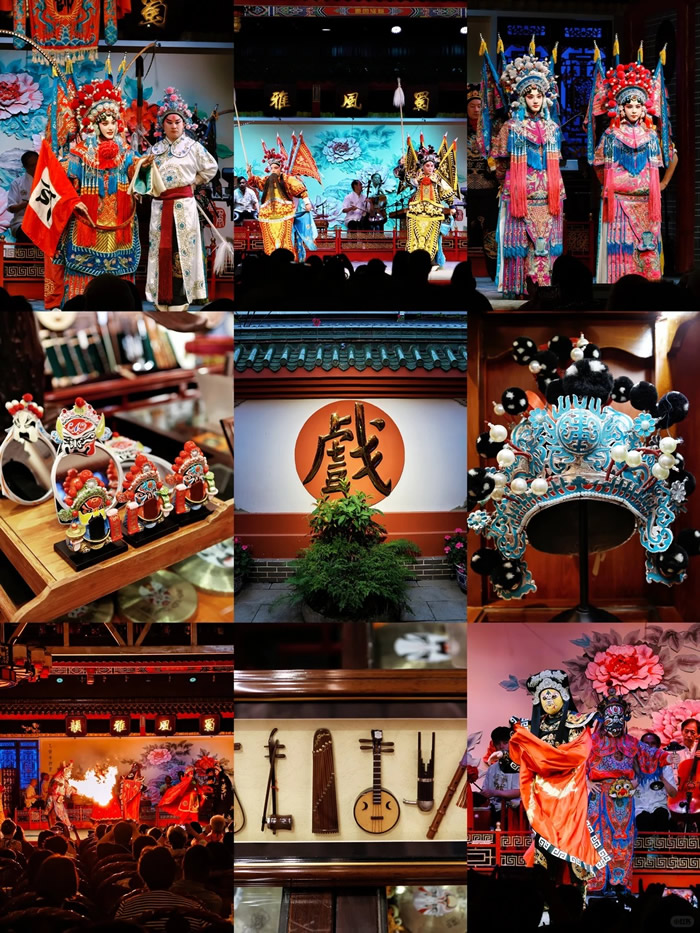
End a Chengdu day the way locals do, with a performance of Sichuan opera. The star act is bian lian — face changing — in which performers switch a cascade of painted masks in the blink of an eye, a skill that remains a closely guarded secret. A full evening show includes shadow puppetry, acrobatics, and comic sketches, with tea and snacks served throughout. Shufeng Yayun Teahouse and the theatres around Jinli are the best-known venues; tickets are easily booked through your hotel or online.
10. Jiuzhaigou Valley & Huanglong (2–3 Days)
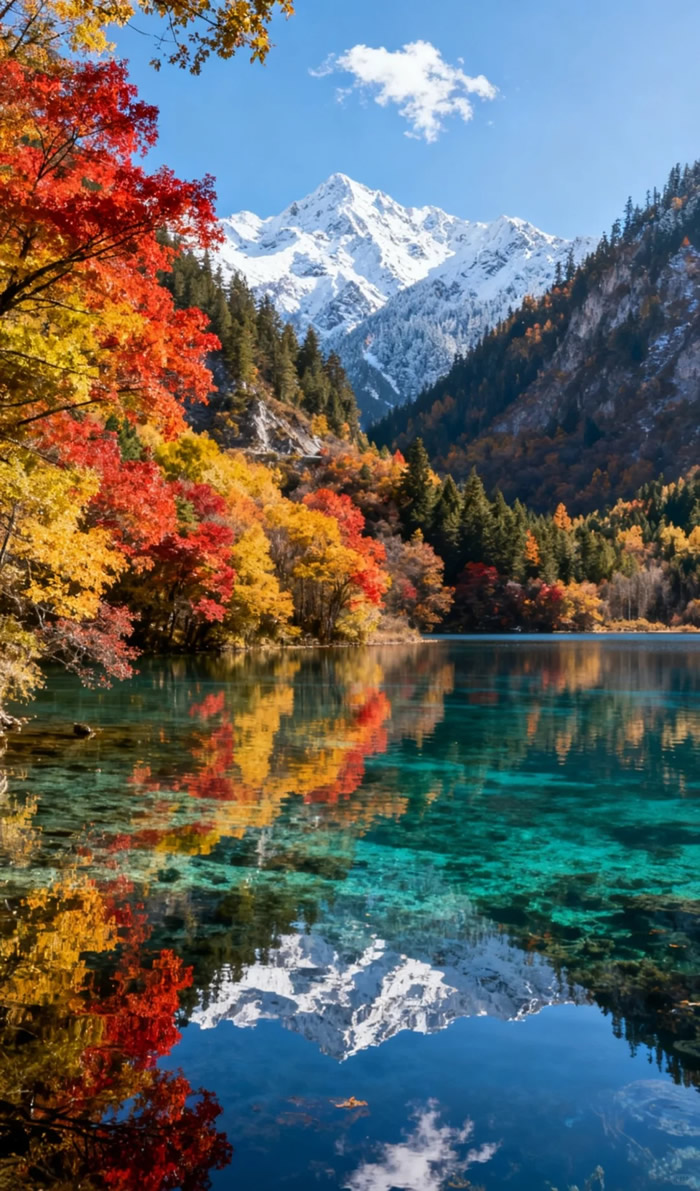
For the grandest landscape in all of Sichuan, travel two hours northwest of Chengdu to Jiuzhaigou Valley, a UNESCO World Heritage site where turquoise lakes, waterfalls and snowy peaks compose what the Chinese call “a fairyland on earth.” The valley’s ninety or so lakes range from deep sapphire to jade green — the water so clear that the submerged tree trunks seem suspended in air. Visit between mid-October and early November, when the autumn forest fires gold and crimson against the blue water, for the single most photographed landscape in China. The day after Jiuzhaigou, add Huanglong, its dazzling neighbour: terraced travertine pools in every shade of blue and gold, ringed by virgin forest. Both sites sit high in the mountains — Jiuzhaigou between 2,000 and 3,100 metres, Huanglong higher still — so move slowly, drink water and let your body adjust.
Getting Around Chengdu
Chengdu’s transport is excellent, cheap and well signposted in English. The city runs one of the largest Metro networks in China, the two airports are connected by express Metro lines, and the high-speed rail network puts Leshan, Mount Emei, Dujiangyan and Qingcheng within an hour or two of the city centre. Here is everything you need.
Arriving by Air — Two Airports, Both Connected
Chengdu is one of the few cities in the world served by two international airports. Most international flights land at Tianfu (TFU), the newer hub far to the east; some regional and domestic flights still use Shuangliu (CTU), much closer to town. Check your ticket carefully, because the two are a long way apart — and both are well connected by Metro.
Table 1 Chengdu’s two airports at a glance (checked September 2026)
Shuangliu Airport (CTU) | Tianfu Airport (TFU) | |
Distance to centre | ~16 km | ~50 km |
Metro line | Line 10 (2–6 yuan) | Line 18 (2–10 yuan) |
Metro time | ~20–30 min to town | ~33–60 min to South Railway Station (express ~33 min) |
Taxi estimate | CNY 40–70 (20–30 min) | CNY 100–150 (50–70 min) |
Extra option | Intercity train from T2 to Chengdu East (~10–16 min) | High-speed train to Chengdu East (27–29 min, CNY 23) |
Both Metro lines run from about 6:00 to 23:00–23:30 with trains every few minutes. If you are connecting between the two airports, allow at least 2.5 hours: Metro Lines 18 and 19 link them in about 50 minutes.
Inside the City — the Metro Is Your Best Friend
Chengdu Metro is modern, air-conditioned and fully bilingual. Buy a single ticket at a machine (they accept cash and international cards via the English interface) or, better, top up a transport card — or simply scan the QR code the machine prints with your phone. Trains come every 2–6 minutes in the daytime. The lines you will actually use are few and easy to remember.
Table 2 Metro lines to the main sights (checked September 2026)
Sight | Metro line & station | Note |
Panda Base | Line 3 → Panda Avenue | Then shuttle or taxi to the gate |
Kuanzhai Alley | Line 4 → Kuanzhai Alley | Exit B, walk in |
Wuhou Shrine & Jinli | Line 3 → Gaoshengqiao (or Line 10) | About 10 min walk to the shrine |
Du Fu Thatched Cottage | Line 4 → Caotang North Road | 10 min walk to the south gate |
People's Park | Line 2 → People's Park | Teahouse near the west gate |
Chunxi Road & Taikoo Li | Line 2 / 3 → Chunxi Road | Heart of the shopping district |
Chengdu South Railway Station | Line 1 / 7 / 18 | For trains to Leshan & Emei |
Xipu (for Dujiangyan) | Line 2 / 6 → Xipu | Change at the same platform to intercity trains |
Beyond the City — High-Speed Rail & Intercity Trains
Chengdu is the launchpad for the region’s greatest day trips, and the trains make them almost absurdly easy. Trains from Chengdu East and Chengdu South stations run all day to Leshan and Emeishan; from Xipu station, intercity trains run like a suburban Metro to Dujiangyan and Qingchengshan. Book tickets on the official 12306 app or via your travel agency; during holidays, book several days ahead.
Table 3 Day-trip trains from Chengdu (checked September 2026)
Destination | From | Travel time | Second-class fare |
Leshan (Giant Buddha) | Chengdu East / South | ~46–60 min | CNY 27–54 |
Emeishan (Mount Emei) | Chengdu East / South | ~1–1.5 h | CNY 39–65 |
Dujiangyan | Xipu (via Line 2 / 6) | ~20–25 min | from CNY 10 |
Qingchengshan | Xipu (via Line 2 / 6) | ~25–30 min | from CNY 10 |
Taxis, Ride-Hailing and Practical Tips
• Taxis & ride-hailing. Taxis are metered and inexpensive; the flag fall is about CNY 8–9. Ride-hailing apps (Didi) are convenient and can be set to English.
• Peak hours. Avoid the morning rush (7:30–9:30) and evening rush (17:30–19:30) when the centre is congested; the Metro is usually faster.
• Language. A translation app is genuinely useful — street signs are bilingual, but menus and small shops often are not.
• When to come. Summer is hot and humid (over 30°C); spring and autumn are mild and ideal. Winters are cold but rarely freezing.
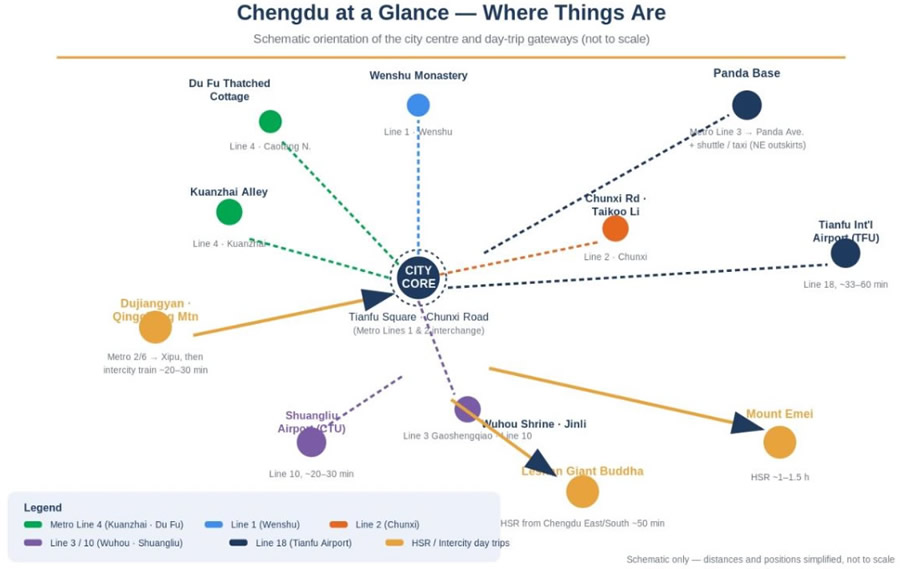
Reading the City — a Map in Words and a Simple Diagram
Chengdu’s layout is unusually easy to grasp. Think of Tianfu Square as the centre of a clock face:
• To the west — Kuanzhai Alley and the Du Fu Cottage, around nine to ten o’clock;
• To the north — Wenshu Monastery and the railway station district beyond it;
• To the east — Chunxi Road and Taikoo Li, the modern heart;
• To the south — Wuhou Shrine and Jinli, with the South Railway Station further down the same line.
Beyond the city, the compass continues to make sense: the Panda Base is in the northeast suburbs; Dujiangyan and Qingcheng Mountain lie to the northwest, reached by the intercity trains from Xipu; and Leshan and Mount Emei run down the high-speed line to the south. If you can picture this simple shape, you will never feel lost in Chengdu.
Suggested Itineraries
Three Days — the Essence of Chengdu
Day 1 begins at the Panda Base at opening time, then returns to town for Kuanzhai Alley in the afternoon and Sichuan opera in the evening. Day 2 pairs Wuhou Shrine and Jinli in the morning, followed by Du Fu’s cottage and a slow tea afternoon in People's Park. Day 3 is for the modern city — Chunxi Road and Taikoo Li — with time to wander, shop and eat your way through the afternoon before an evening stroll in Jinli’s lantern light.
Five Days — Chengdu Plus the Icons Beyond
Add two of the great day trips to the three-day plan. On Day 4, take the morning intercity train to Dujiangyan, walk the ancient irrigation works, continue to Qingcheng Mountain for the Taoist peaks, and return by evening train. On Day 5, ride the high-speed line south: Leshan’s Giant Buddha in the morning, then on to Mount Emei for an overnight stay if you want to catch the famous summit sunrise — or simply return to Chengdu the same evening. Eastertrip.com can arrange every train, guide and ticket for you, in any combination that fits your pace.
Plan Your Sichuan Journey with Eastertrip.com
This guide is brought to you by Eastertrip.com, a brand of Zhangjiajie CITS International Travel Service Co., Ltd. — a key member of the China International Travel Service Group in Hunan Province. With over thirty years of industry experience, multilingual guides and a professional fleet, we are ready to turn this guide into a seamless, worry-free journey — in Chengdu, Zhangjiajie, and across China.
• Tel: (0086) 744-8288222 / 8288000
• Email: citsliyong@qq.com
• Address: A2, 3rd Floor, Building A, Dushi Jinyuan, Xixiping Sub-district, Yongding District, Zhangjiajie City, Hunan Province, China
For customised tours, private guides, hotel and train bookings, or a complete itinerary across Sichuan and Hunan, simply write to us — we reply within one business day.
Sources & Notes
Facts, hours, fares and train times in this guide were checked in September 2026 against official and major booking sources, including the Chengdu Panda Base (panda.org.cn), Chengdu airport Metro information, China Railway and Ctrip train schedules. Schedules, prices and opening hours change — always verify on the official website before travel. All illustrations in this document are original artwork created for Eastertrip.com.
• Chengdu Panda Base — tickets & hours: panda.org.cn
• Chengdu airport Metro lines 10/18/19: cdairport.com; travelchina.tips
• Chengdu–Leshan / Emeishan trains: ctrip.com train booking
• Xipu–Dujiangyan / Qingchengshan intercity trains: china-railway.com.cn; ctrip.com